


Imagine this.
You’re a guest on a popular business podcast. The host loves your product and tells thousands of listeners to check out your company.
You didn’t pay for the exposure.
The audience is exactly your target market.
But there’s one problem.
Half the listeners don’t know how to spell your company name.
Some type it incorrectly.
Others guess the wrong domain.
A few give up entirely.
That single branding mistake turns valuable publicity into missed opportunities.
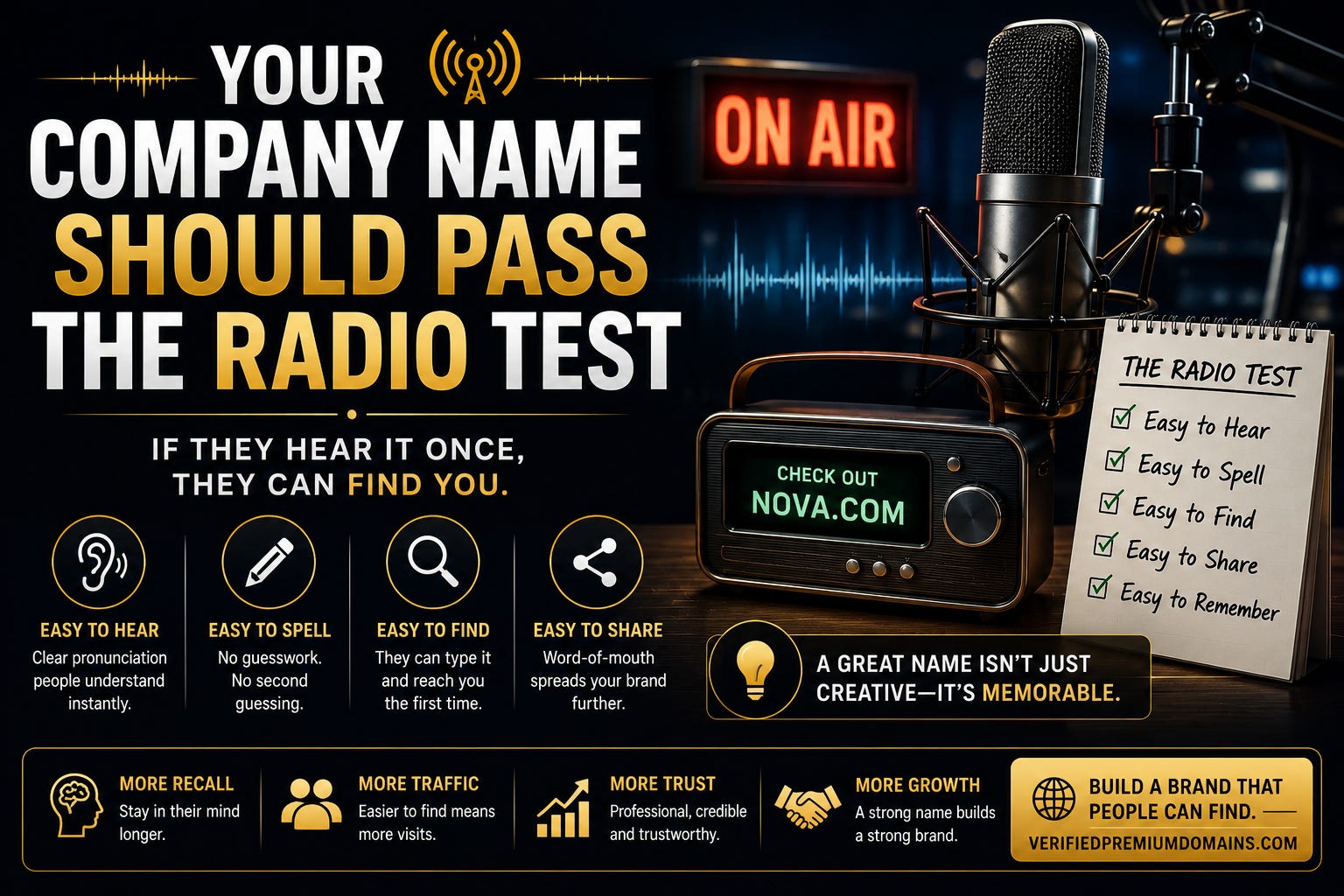
This is why marketers often talk about the Radio Test.
What Is the Radio Test?
The Radio Test is simple.
Imagine someone hears your company name—but never sees it written down.
Can they:
Spell it correctly?
Type the right domain?
Find your website on the first try?
If the answer is yes, your brand passes.
If the answer is no, every mention of your business creates friction.
Why It Matters More Than Ever
Today’s customers discover brands in countless ways:
Podcasts
YouTube interviews
Webinars
Conference presentations
Networking events
Voice assistants
Word-of-mouth recommendations
In many of these situations, your audience only hears your name.
They don’t see your logo.
They don’t see your website.
They rely entirely on memory and pronunciation.
A confusing name makes that journey much harder.
A Simple Experiment
Imagine someone recommends these two companies over the phone.
Company A
Nova.com
Company B
N0vaAI-SolutionsHQ.io
Which one would you type correctly without asking for clarification?
The easier your name is to hear, the easier it is to find.
The Most Common Ways Brands Fail the Radio Test
Many startups unintentionally make their names harder to remember.
Here are some common pitfalls.
Unusual Spellings
Creative spellings may seem distinctive, but they often create confusion.
Examples:
Lyfft instead of Lift
Kwik instead of Quick
Xpress instead of Express
Every correction you have to make is another obstacle for potential customers.
Numbers
Numbers introduce uncertainty.
If someone hears:
FiveStar
Do they type:
FiveStar
5Star
Five-Star
The uncertainty slows people down and increases the chance they’ll end up somewhere else.
Hyphens
Hyphens are easy to forget.
When spoken aloud, people rarely remember where they belong.
A domain without unnecessary punctuation is almost always easier to share.
Long Compound Names
The more words you add, the harder they become to remember.
Compare:
CloudPilot
with
AdvancedCloudInfrastructureSolutions
One is easy to repeat.
The other is easy to forget.
Difficult Pronunciation
If customers hesitate before saying your company’s name, they’ll hesitate before recommending it.
Word-of-mouth marketing depends on confidence.
Choose a name that people can pronounce naturally after seeing it once.
Your Domain Is Part of the Test
Passing the Radio Test isn’t only about your company name.
Your domain matters just as much.
Suppose your brand is called Nimbus.
Which website would most people expect?
Nimbus.com
or
NimbusCloudTechSolutions.net
A memorable name paired with a memorable domain creates a seamless customer experience.
Why Big Brands Rarely Need to Spell Their Names
Think about hearing these companies mentioned in a conversation:
Stripe
Canva
Zoom
Slack
Shopify
Most people can find them immediately.
Not because they’re famous.
Because their names are:
Short
Clear
Easy to pronounce
Easy to spell
Their branding reduces effort.
That’s exactly what your startup should aim for.
The Cost of Failing the Radio Test
When customers can’t remember your name correctly, the consequences extend far beyond one missed visit.
You may lose:
Website traffic
Sales opportunities
Referrals
Media coverage
Investor interest
Speaking-event exposure
Partnership opportunities
Every conversation becomes slightly less effective.
Over time, those small losses compound.
How to Test Your Name Before You Launch
Before registering your company, try this simple exercise.
Ask five people who have never seen your brand to do the following:
Listen as you say the company name once.
Wait a few minutes.
Ask them to write down the name.
Ask them what domain they would type.
If several people spell it differently or guess the wrong website, you’ve identified a problem before your customers do.
Questions Every Founder Should Ask
Before committing to a brand name, ask yourself:
Can someone spell it after hearing it once?
Is the pronunciation obvious?
Does it sound natural in conversation?
Will people know which domain to visit?
Does it avoid unnecessary symbols, numbers, or unusual spellings?
Is the matching .com available or realistically obtainable?
If the answer to most of these questions is yes, your brand is already ahead of many competitors.
Memorable Brands Spread Faster
The best brands don’t need constant explanation.
People hear them once.
Remember them later.
Recommend them confidently.
That’s not an accident.
It’s the result of choosing a name that works with human behavior rather than against it.
A great product may win customers.
A memorable name helps customers find that product in the first place.
Final Thoughts
Your company name is one of the few business decisions that influences every future interaction—marketing, sales, customer support, investor meetings, and referrals.
If people can’t remember it, spell it, or type it correctly after hearing it once, you’re creating friction that no advertising campaign can completely overcome.
Aim for clarity over cleverness.
Choose a name that’s easy to hear, easy to search, and easy to share.
Because the brands that spread the fastest are usually the ones people never have to ask, “Can you spell that?”