


Imagine walking into a casino where domains are the currency.
At first glance, everything looks the same: flashing lights, constant motion, people placing bets, stories of wins being shared loudly. But look closer, and you’ll notice something important.
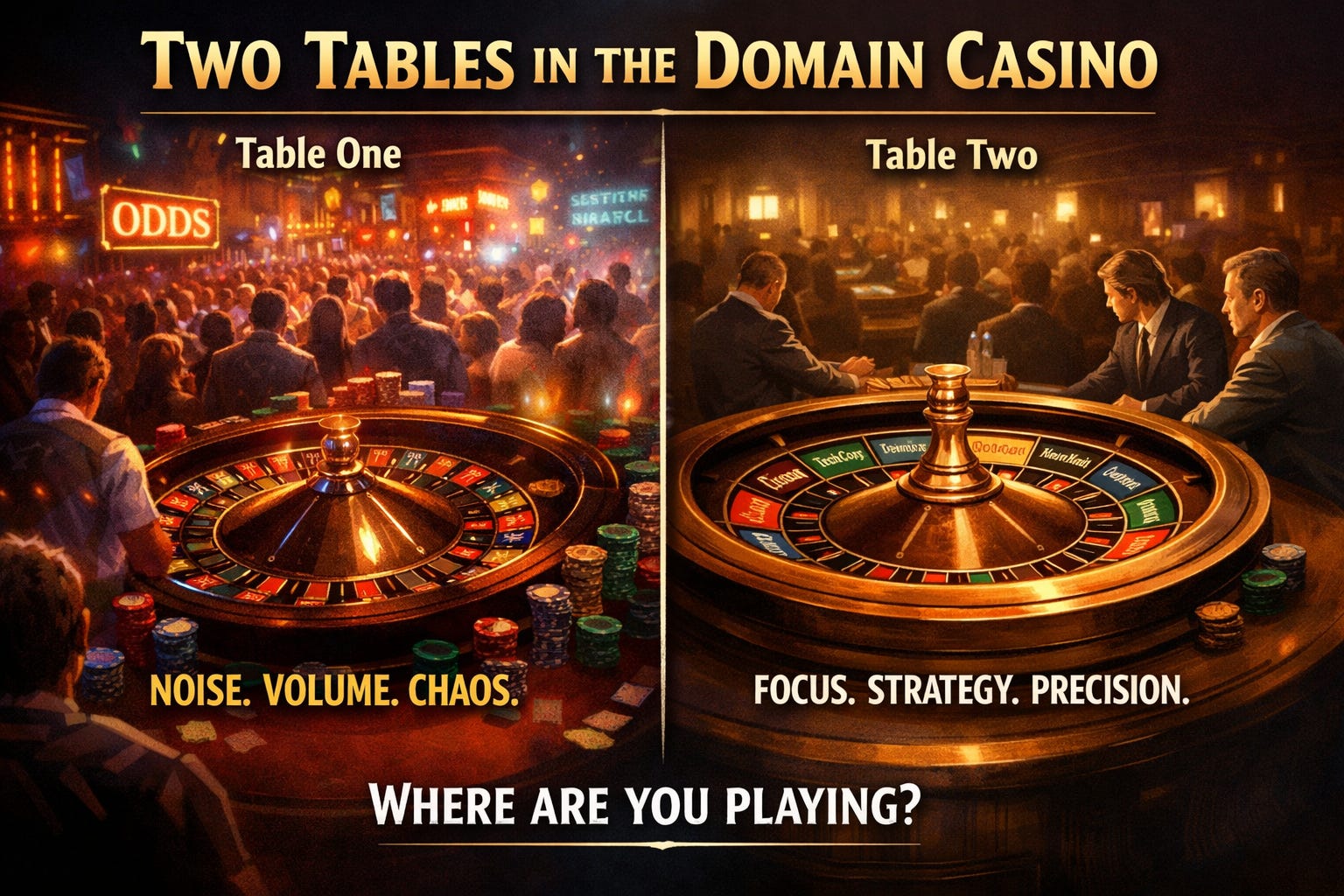
There aren’t one or two games happening.
There are two entirely different tables.
Table One: Volume, Noise, and Motion
The first table is impossible to miss.
It’s crowded. Loud. Constantly in motion.
Hundreds—sometimes thousands—of domains are in play. New ones are added every day. The wheel spins nonstop. Red, black, green. Trends change. Extensions multiply. New theories arrive every year promising easier wins.
Almost everyone starts here.
The bets are small. The barriers are low. Participation feels productive because there’s always activity. Something is always “happening.”
But if you watch long enough, a pattern becomes clear.
Most players stay for years.
Most portfolios grow wider, not stronger.
Most exits are small, forgettable, or never happen at all.
There’s nothing wrong with playing here—but it’s a table built on probability, churn, and patience without leverage. The house always gets paid. The wheel never slows down.
People tell themselves they’re one good spin away.
They’ve been telling themselves that for a long time.
Table Two: Silence, Selectivity, and Timing
Now look across the room.
The second table doesn’t draw attention.
It’s quiet. Almost empty. No spectacle. No crowd cheering each spin. Just a few players sitting calmly, watching—not rushing.
This wheel doesn’t use numbers.
Every slot has a name.
Real businesses.
Serious operators.
Companies with budgets, urgency, and market pressure.
Nothing spins unless there’s a reason.
At this table, participation is intentional. No one is here because they’re bored, impatient, or afraid of missing out. They’re here because timing, positioning, and relevance have aligned.
And when this wheel hits, it doesn’t produce applause.
It produces impact.
Same Industry. Two Completely Different Games.
Both tables exist in the same casino.
Both involve domains.
Both require patience.
But they reward entirely different behaviors.
Table One rewards activity.
Table Two rewards discipline.
Table One favors volume.
Table Two favors precision.
Table One celebrates motion.
Table Two waits for inevitability.
Most people never leave the first table—not because they can’t, but because leaving requires something uncomfortable: standing apart from the crowd.
The Cost of Playing Quietly
Choosing the second table comes with trade-offs.
There’s less visibility.
Fewer conversations.
Less validation from peers.
You don’t look busy.
You don’t sound exciting.
You don’t get applauded often.
But over time, something else happens.
You develop credibility.
Credibility doesn’t come from being everywhere.
It comes from being right—consistently.
It comes from holding assets that don’t need explanation.
From names that speak for themselves.
From opportunities that don’t rely on luck, but on logic.
That credibility compounds quietly, just like the assets behind it.
Why Time Matters More Than Hype
The domain industry has always tested patience.
Trends rise fast.
Advice spreads faster.
Certainty is often loud—and often wrong.
But time has a way of filtering noise from substance.
Strong domains age well.
Weak strategies eventually expose themselves.
Facts don’t need defending forever—they simply wait.
This is why the domain game, when played correctly, is less about winning often and more about not losing badly.
The longer the horizon, the more the odds favor restraint.
Choosing the Table
There’s no rule saying everyone must play the same way.
Some will always prefer the energy of the crowd.
Others will chase motion because stillness feels risky.
But the investors who last—the ones who exit on their terms—are usually found at the quieter table.
Not because they were smarter.
Not because they were louder.
But because they were willing to wait.
In a casino built on impatience, patience becomes the edge.
So the question isn’t which table looks more exciting.
It’s which table you want to be at when the room finally shakes.