


Every day, we’re exposed to thousands of brand names.
Most are forgotten almost instantly.
Yet names like Apple, Nike, Stripe, Zoom, Amazon, and Canva are recognized around the world.
What makes them different?
It’s not simply marketing budgets or product quality.
The human brain is naturally wired to remember certain types of names better than others.
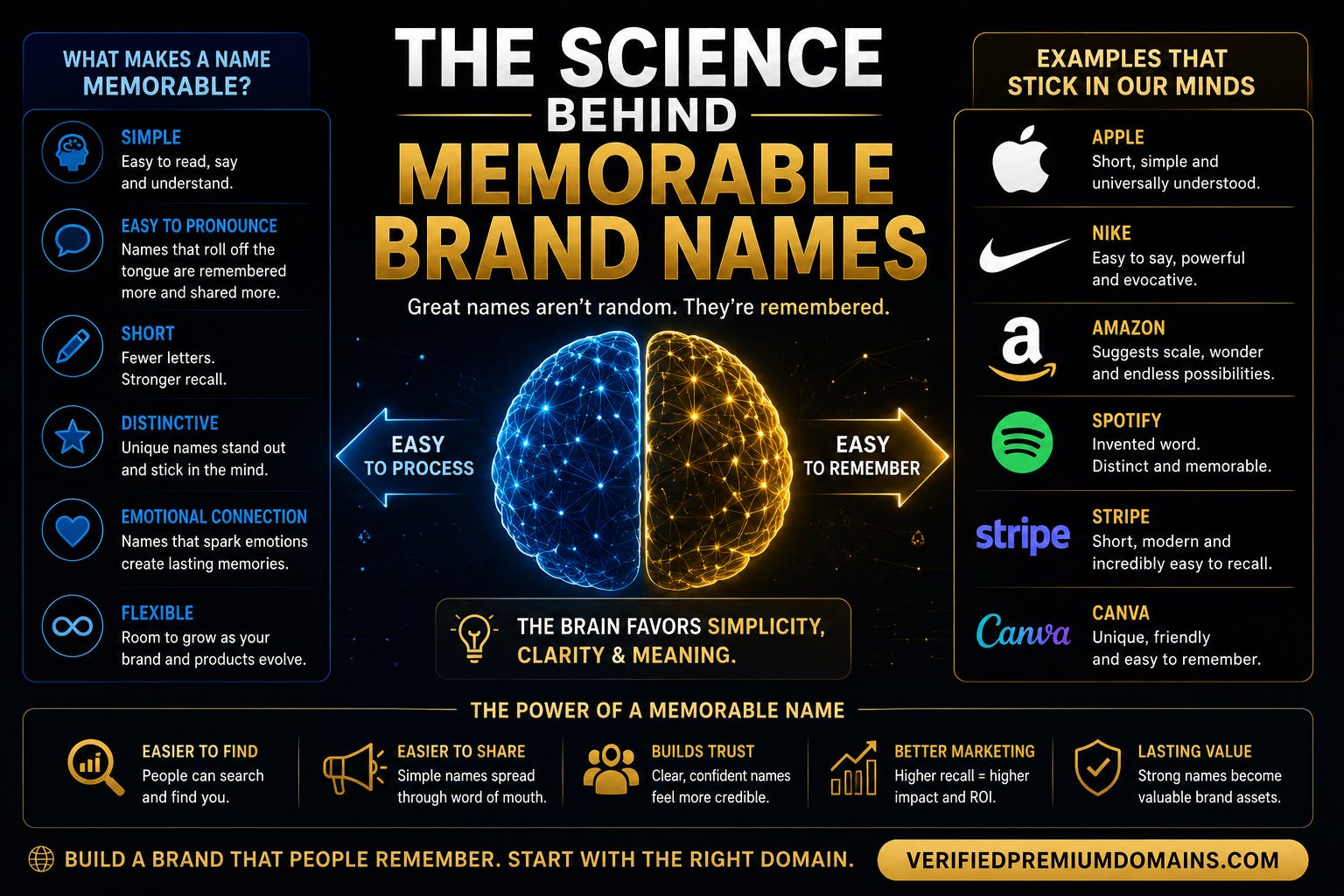
Understanding the science behind memorable brand names can help founders choose names that are easier to recall, easier to recommend, and easier to build into valuable businesses.
Your Brain Loves Simplicity
The human brain constantly looks for shortcuts.
It prefers information that’s easy to process.
Psychologists call this processing fluency—the easier something is to understand, the more likely people are to trust and remember it.
Compare these two names:
NeuroFlow
AdvancedNeuralAutomationSolutions
Which one requires less mental effort?
Simple names reduce cognitive load, making them easier to recognize and recall.
Short Names Stay Longer in Memory
There is a reason many of the world’s biggest brands use one or two words.
Short names are:
Faster to read
Easier to pronounce
Easier to spell
Easier to search
Easier to share
Think about these companies:
Apple
Uber
Canva
Stripe
Zoom
Slack
Adobe
None of them rely on long descriptions.
Their names are compact enough to become part of everyday conversations.
Pronunciation Matters More Than You Think
Researchers have found that people often rate easy-to-pronounce names more positively than difficult ones.
This effect influences everything from trust to perceived credibility.
Imagine recommending a company to a friend.
If you struggle to pronounce the name, you’re less likely to mention it again.
Word-of-mouth marketing depends on names people can confidently say out loud.
Distinctiveness Creates Recall
Being memorable doesn’t always mean being descriptive.
In fact, highly descriptive names often blend together.
Consider names like:
SmartAI Solutions
FutureTech Labs
Digital Automation Group
Now compare them with:
Notion
Stripe
Spotify
Canva
Distinctive names stand apart because they don’t sound like everyone else.
The brain remembers differences.
Emotion Strengthens Memory
People remember experiences that create emotion.
Brands can benefit from the same principle.
A name that sparks curiosity, imagination, or positive associations is more likely to stay in someone’s mind.
For example:
Amazon suggests scale and endless possibilities.
Nike evokes speed and victory.
Patagonia creates a sense of adventure.
The strongest names often carry meaning beyond the product itself.
The Power of Repetition
Every interaction reinforces a brand.
Customers may encounter your name through:
Google searches
Emails
Social media
Podcasts
Advertisements
Business cards
Conversations
The easier your name is to repeat and recognize, the faster familiarity grows.
And familiarity builds trust.
Avoid the “Descriptive Trap”
Many startups choose names that explain exactly what they do.
Examples include:
BestPayrollSoftware
OnlineInvoiceGenerator
AIContentAssistant
These names may describe today’s product, but they rarely become lasting brands.
Products evolve.
Markets change.
Strong brands leave room for growth.
The Radio Test
One of the simplest ways to evaluate a brand name is with the Radio Test.
Imagine someone hears your company mentioned in a podcast or at a conference.
Can they:
Spell it correctly?
Search for it?
Remember it later?
If the answer is no, your brand may be creating unnecessary friction.
The Role of Your Domain
A memorable brand deserves a memorable domain.
Imagine discovering a company called Nova.
Which website would you expect?
Nova.com
or
NovaAIPlatformSolutions.net
The domain reinforces the memory created by the name.
When both are simple and aligned, customers are more likely to return, recommend the business, and trust the brand.
Memorability Compounds Over Time
Every positive interaction with your brand strengthens recognition.
Each customer who remembers your name without searching for it is one less customer you have to reacquire through advertising.
That’s why memorable brands often enjoy:
More direct traffic
Better word-of-mouth referrals
Stronger brand searches
Higher customer retention
Lower marketing friction
A memorable name becomes a competitive advantage that compounds over time.
Questions Every Founder Should Ask
Before choosing a brand name, consider these questions:
Can someone pronounce it after seeing it once?
Can they spell it correctly?
Will they remember it tomorrow?
Does it sound different from competitors?
Is it flexible enough to support future growth?
Is the matching .com available or realistically obtainable?
If the answer to most of these questions is yes, you’re building a stronger foundation for your brand.
Great Brands Aren’t Accidents
The companies we remember didn’t become memorable overnight.
They chose names that were easy to understand, easy to share, and capable of growing alongside the business.
Your name doesn’t have to explain everything.
It simply has to make people curious enough to remember it.
Because in a world where attention is limited, the brands people remember are often the brands they choose.
Final Thoughts
A memorable brand name is more than a creative exercise—it’s a strategic business decision rooted in psychology.
Simple, distinctive, easy-to-pronounce names reduce friction, improve recall, and strengthen every marketing effort that follows.
Pair that with a premium domain, and you create a brand that’s not only easier to find, but also far harder to forget.
The science is clear:
People remember what their brains can process easily.
Build your brand around that principle, and you’ll give your business an advantage that lasts far beyond launch day.