


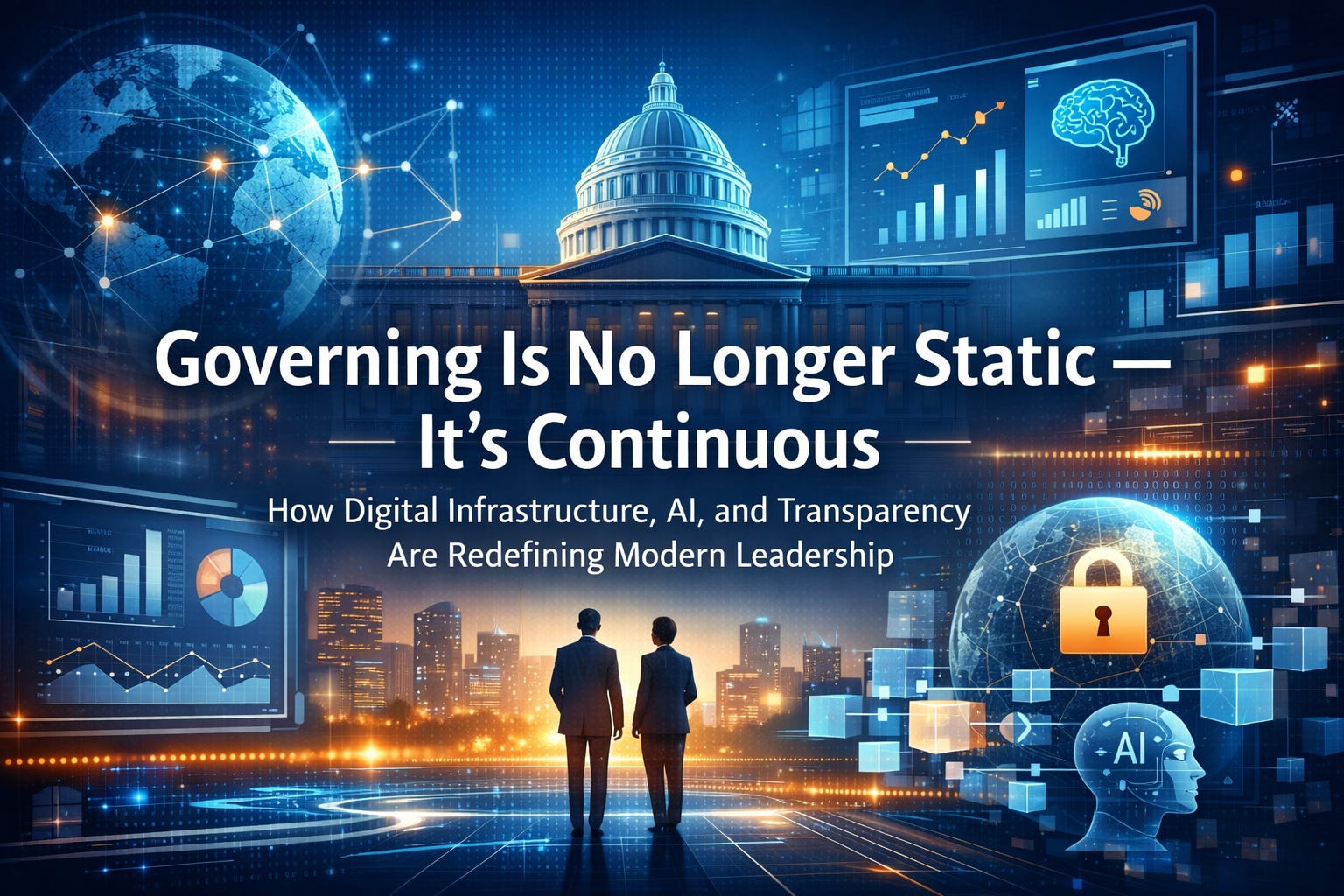
Governance is no longer a static framework of rules and paperwork.
It is becoming dynamic. Responsive. Data-driven.
Across the world, governments, regulatory bodies, institutions, and even corporations are being forced to rethink how they operate in a digital-first world. Transparency expectations are rising. Policy cycles are accelerating. Public scrutiny is immediate.
Governance is evolving from an annual report into a real-time interface.
The Shift From “Government” to “Governing”
For decades, governance was seen as structural — something defined by constitutions, charters, and compliance manuals.
Today, it is behavioral.
It is about how decisions are made, how policies are communicated, how accountability is demonstrated, and how stakeholders are engaged in real time.
This shift moves us from the idea of “government” as a noun to “governing” as a verb.
And that difference matters.
Because modern governing requires:
Continuous data analysis
Transparent reporting dashboards
Digital public participation
AI-assisted policy simulation
Cross-border regulatory collaboration
Governance is no longer occasional. It is ongoing.
The Rise of Governance Tech
We are witnessing the rapid growth of:
GovTech startups
Regulatory technology platforms
Civic engagement software
ESG compliance dashboards
Digital public infrastructure initiatives
From smart cities to AI policy monitoring, institutions are investing heavily in systems that make governing more efficient, accountable, and participatory.
The institutions that succeed in the next decade will not just have governance frameworks.
They will operate governing systems.
Why Language Shapes Authority
In the digital age, authority is shaped by clarity.
The brands that define industries often adopt language that reflects movement and capability rather than structure.
FinTech. LegalTech. RegTech. InsurTech.
But governance remains linguistically anchored in the past.
As institutions modernize, the language around governance must evolve too — toward something more active, intelligent, and digital-first.
Toward governing — continuously, transparently, and globally.
The Opportunity Ahead
We are entering a decade where:
AI will assist policy drafting
Blockchain will secure public records
Digital IDs will transform public services
Real-time analytics will guide regulatory decisions
The future of governance is not static. It is living.
It is governing — intelligently and continuously.
And the organizations that understand this shift early will shape the frameworks the rest of the world follows.
Final Line
In a world moving toward intelligent, real-time governing, the language — and the platforms — that define this era will matter more than ever.
As governance becomes digital and continuous, the brand defining it matters more than ever.
Names shape perception. Perception shapes authority.
Governingly.com is now available to acquire.