


Premium domains have become valuable business assets, and just like commercial real estate or specialized equipment, there are now multiple ways to acquire them.
For founders and growing businesses, understanding the differences can help you make a smarter financial decision.
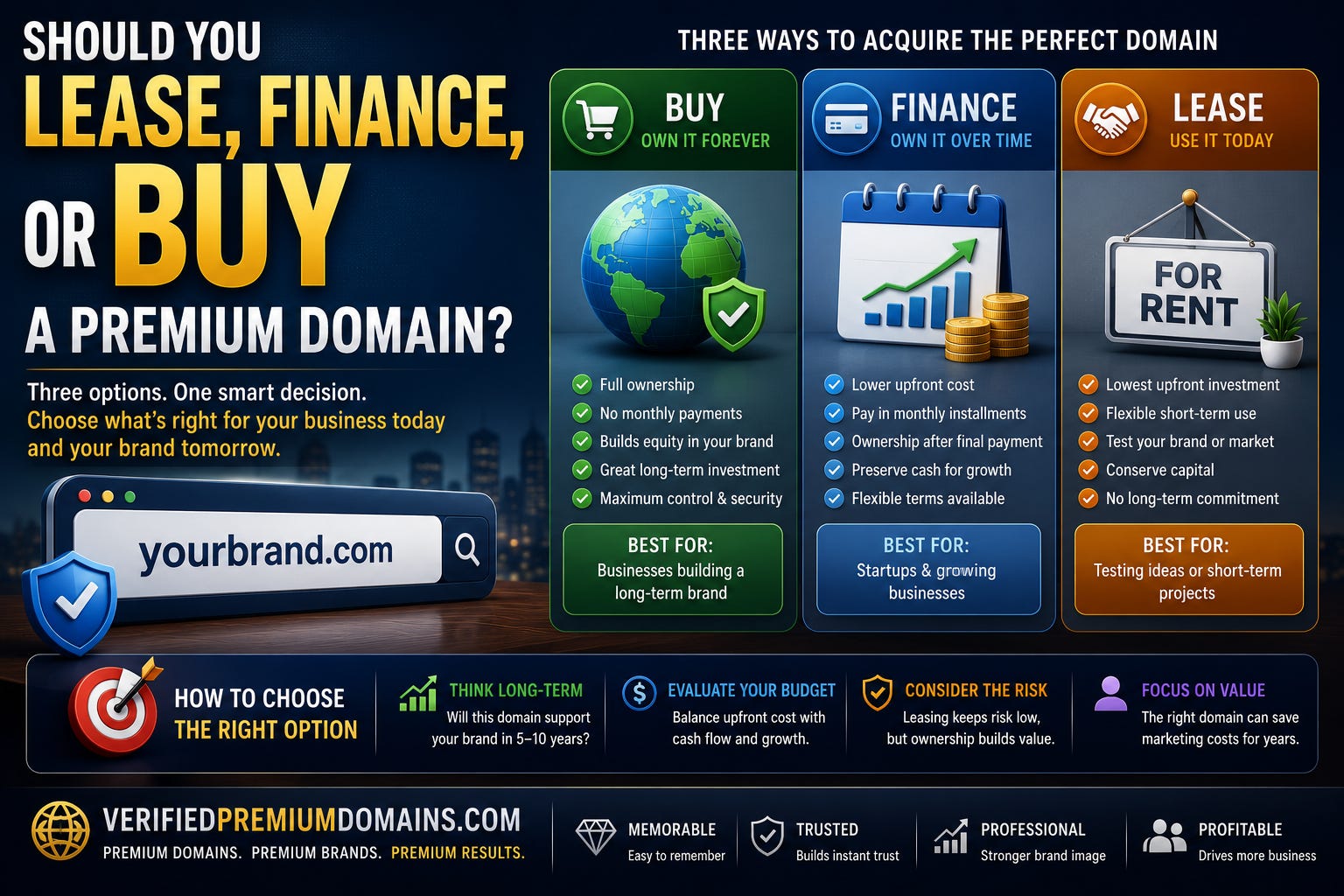
Let’s explore the advantages and trade-offs of each option.
Option 1: Buying a Premium Domain
Buying means you become the full owner of the domain after the transaction is complete.
There are no future payments.
No restrictions.
No uncertainty about ownership.
For many businesses, this is the strongest long-term option.
Advantages
Complete ownership
No monthly payments
The domain becomes a business asset
Full control over branding
No renewal negotiations with the seller
Potential long-term appreciation in value
If your domain becomes central to your brand, owning it outright removes risk and gives you complete control over your digital identity.
When Buying Makes Sense
Buying is often the best choice when:
The domain will be your primary company website.
You’re building a long-term brand.
You have available capital.
You want to avoid future ownership uncertainty.
The domain is difficult or impossible to replace.
For many successful companies, their domain becomes one of their most valuable intangible assets.
Option 2: Financing a Premium Domain
Financing allows you to spread the purchase price across monthly payments.
Instead of paying everything upfront, you pay over a fixed period while working toward ownership.
Many premium domain marketplaces and brokers now offer financing for qualified buyers.
Advantages
Lower upfront cost
Preserves cash for hiring and growth
Allows startups to secure stronger branding earlier
Ownership is typically transferred after completing payments
Easier budgeting for growing businesses
Instead of settling for a weaker domain today, financing may allow you to secure the brand you actually want.
When Financing Makes Sense
Financing can be a smart option if:
Cash flow matters more than minimizing total cost.
You’re investing heavily in product development.
Marketing budget is limited.
The domain is strategically important.
Waiting could mean losing the opportunity.
Many founders would rather invest in the right domain today than risk someone else buying it tomorrow.
Option 3: Leasing a Premium Domain
Leasing means you pay for the right to use a domain without owning it.
The seller retains ownership unless your agreement includes a future purchase option.
This is similar to renting commercial office space.
You can operate your business there, but you don’t own the property.
Advantages
Lowest upfront investment
Access to premium domains that may otherwise be unaffordable
Useful for testing new brands or markets
Conserves capital during early growth
For some startups, leasing provides flexibility while validating a business idea.
The Risks of Leasing
Leasing isn’t always the best long-term strategy.
Potential drawbacks include:
You don’t own the asset.
Lease terms may expire.
Monthly payments continue indefinitely.
Renewal terms could change.
Your business depends on an asset controlled by someone else.
Imagine building a nationally recognized brand only to discover you no longer control the domain.
That’s a risk every founder should consider carefully.
Comparing All Three Options
FactorBuyFinanceLeaseOwnershipImmediateAfter final paymentNoUpfront CostHighestModerateLowestMonthly PaymentsNoneYesYesLong-Term ValueExcellentExcellentLimitedBusiness AssetYesYes (after payoff)NoBranding SecurityHighestHighLower
Which Option Is Best for Startups?
There isn’t one answer for every company.
The best choice depends on where your business is today.
Bootstrapped Startup
Financing often provides a good balance between cash flow and long-term ownership.
Venture-Backed Startup
Buying outright may make sense if branding is central to your growth strategy and capital is available.
Testing a New Business Idea
Leasing may reduce initial risk while you validate demand.
However, if the business gains traction, securing ownership should become a priority.
Think Beyond Today’s Budget
Many founders focus only on today’s acquisition cost.
Instead, ask yourself:
What happens if the business succeeds?
Will you still have access to the domain?
Will customers recognize it?
Will investors see it as a strategic asset?
Will changing domains later disrupt years of branding?
Sometimes the cheapest option today becomes the most expensive option tomorrow.
A Premium Domain Is Different From Other Expenses
Software subscriptions expire.
Advertising budgets disappear.
Consulting fees are spent once.
A premium domain is different.
It becomes part of:
Your brand
Your email addresses
Your website
Your marketing
Your investor presentations
Your business valuation
That’s why many founders view premium domains as investments rather than expenses.
Questions to Ask Before Choosing
Before deciding how to acquire a premium domain, consider:
Is this my long-term brand?
Will I still use this domain in five or ten years?
Can I comfortably afford the upfront purchase?
Would financing allow me to preserve cash for growth?
Am I comfortable building my brand on a domain I don’t own?
Your answers will often point toward the best option.
Ownership Brings Peace of Mind
As your business grows, your domain becomes more than a website address.
It becomes part of your reputation.
Customers bookmark it.
Investors see it in pitch decks.
Partners recommend it.
Employees use it every day.
Owning that identity gives you one less thing to worry about as your company scales.
Final Thoughts
Buying, financing, and leasing all have their place.
Leasing offers flexibility.
Financing improves affordability.
Buying provides complete ownership and long-term security.
The right decision isn’t simply about price—it’s about how important your domain will become to your business.
If you believe your brand will still matter years from now, acquiring the right domain is often one of the smartest investments you can make.
Choose the option that aligns with your long-term vision, not just your current budget.