


Most founders spend months building their product.
Many spend weeks perfecting their logo.
But when it comes to naming the company, they often settle for the first available domain or the trendiest buzzword.
Years later, they’re forced to rebrand, acquire a better domain, or explain their name every time they meet a customer.
The cost isn’t just financial.
It’s lost momentum.
Let’s look at the naming mistakes that quietly cost businesses millions—and how you can avoid them.
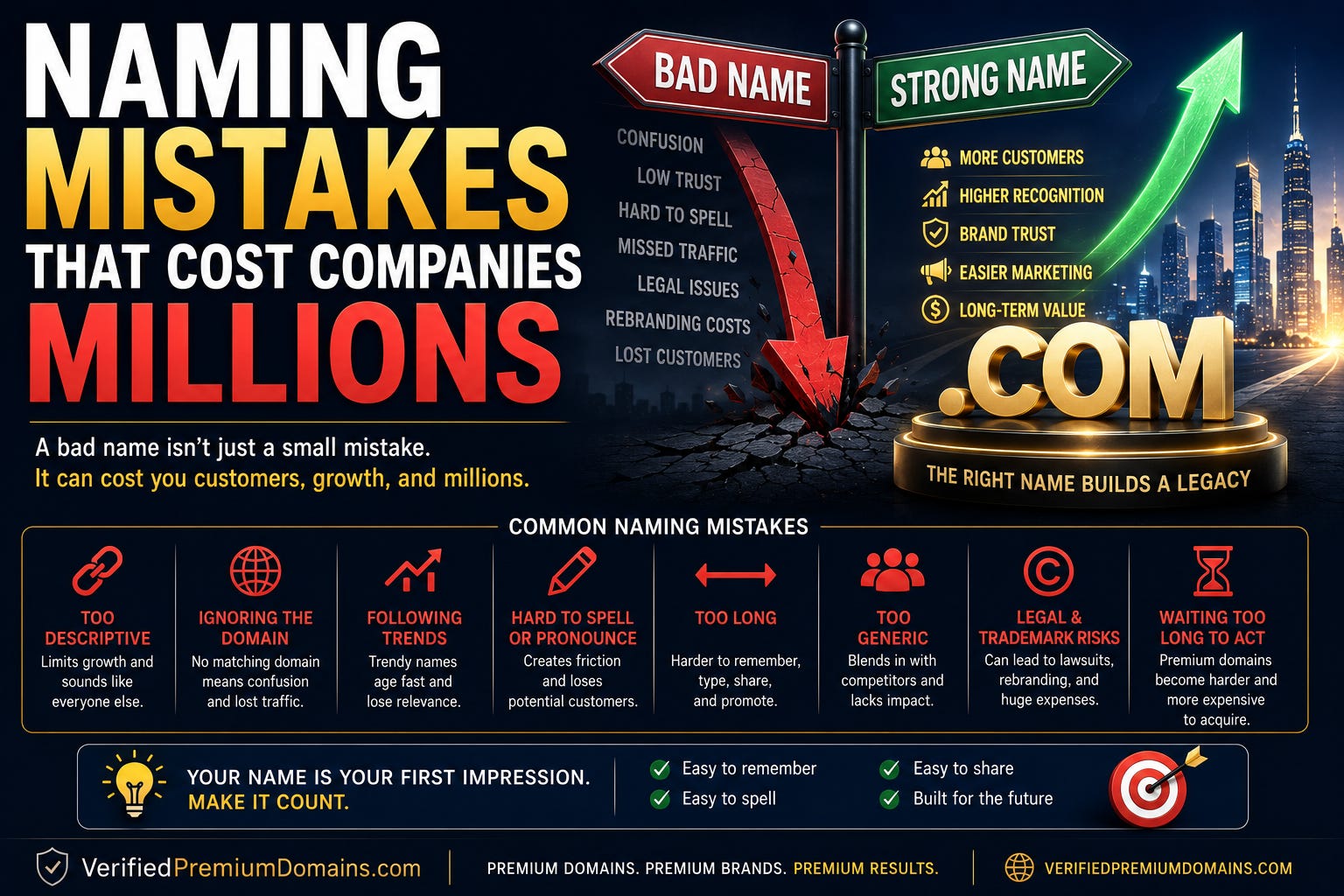
1. Choosing a Name That’s Too Descriptive
Many startups believe their name should explain exactly what they do.
Examples:
BestPayrollSoftware
OnlineInvoiceGenerator
AIContentWriterPro
The problem?
Businesses evolve.
Products change.
Markets expand.
A descriptive name can become outdated as soon as your company launches a second product.
Think about companies like:
Amazon
Apple
Stripe
Canva
None of their names limit what they can become.
Lesson
Choose a name that can grow with your business, not one that locks you into your first product.
2. Ignoring the Domain Name
One of the biggest mistakes founders make is choosing a company name before checking whether they can own the matching domain.
Imagine building a brand called Nova only to discover:
Nova.com is unavailable.
Social media usernames are taken.
Customers keep visiting another company.
Now every marketing campaign starts with an explanation.
Lesson
Your brand and domain should work together.
Always research domain availability before committing to a company name.
3. Following Industry Trends
Every few years, naming trends change.
At one time, nearly every startup added words like:
Tech
Labs
Hub
Cloud
AI
GPT
Solutions
The result?
Hundreds of companies sounding almost identical.
Trend-based names age quickly.
Strong brands don’t chase trends.
They outlast them.
4. Choosing a Name Nobody Can Spell
A unique spelling may seem creative.
In reality, it often creates confusion.
Examples:
Kwik
Lyfft
Xpress
Phaze
Customers shouldn’t need instructions just to find your website.
Every spelling correction becomes another opportunity to lose a visitor.
Lesson
If people can’t spell your name after hearing it once, your branding is working against you.
5. Making the Name Too Long
Long names create friction.
They’re harder to:
Remember
Type
Share
Recommend
Display on mobile devices
Compare:
Vertex.com
with
GlobalBusinessAutomationSolutions.com
One feels like a company.
The other feels like a sentence.
6. Choosing a Name That’s Too Generic
Some founders choose names so broad that they disappear into search results.
Words like:
Digital
Global
Future
Solutions
Business
combined together rarely create memorable brands.
Being generic makes it harder to build recognition.
Lesson
Distinctiveness beats descriptiveness.
7. Forgetting About International Growth
A name that works perfectly in one country may be difficult to pronounce—or even carry unintended meanings—in another.
If your ambition is global, test your name with people from different regions and languages.
A little research today can prevent expensive rebranding tomorrow.
8. Overlooking Trademark Conflicts
Falling in love with a name before checking trademark availability can become an expensive mistake.
Businesses have spent years building brands only to receive legal notices requiring them to stop using their own name.
That can mean replacing:
Your website
Marketing materials
Product packaging
Social media accounts
Customer communications
Lesson
Conduct trademark research early in the naming process.
9. Building Around a Temporary Technology
Technology changes quickly.
Names built around specific trends may not age well.
Imagine companies named:
BlockchainPayments
NFTMarketplace
GPTEverything
If the market shifts, the brand may feel outdated.
A timeless name offers greater flexibility.
10. Thinking a Logo Will Fix a Weak Name
A beautiful logo can’t solve a confusing brand.
Customers remember names.
Logos support them.
If people struggle to remember, pronounce, or search for your company, no amount of graphic design can fully compensate.
Your name is the foundation.
The logo builds on it.
11. Waiting Too Long to Upgrade
Many startups launch with a temporary domain, expecting to upgrade later.
Then the business grows.
The premium domain becomes more valuable.
Negotiations become more expensive.
Or worse, another company acquires it first.
Lesson
If you know which domain you ultimately want, exploring acquisition early may save significant time and money.
12. Choosing Availability Over Quality
One of the most common mistakes is choosing a weak name simply because it’s available to register for a standard fee.
Availability doesn’t automatically make it a good brand.
Sometimes the stronger decision is investing in a memorable premium domain that aligns with your long-term vision.
The Hidden Cost of a Bad Name
A weak name doesn’t appear on your financial statements.
But it affects nearly every part of your business.
It can increase:
Marketing costs
Customer confusion
Misspelled searches
Lost referrals
Lower brand recall
Rebranding expenses
Domain acquisition costs later
These costs accumulate over years—not weeks.
A Better Naming Process
Before choosing a company name, ask yourself:
Is it easy to pronounce?
Is it easy to spell?
Can people remember it after hearing it once?
Does it allow future expansion?
Is the matching .com available or realistically obtainable?
Does it stand out from competitors?
Could it still represent the business ten years from now?
If the answer is “yes” to most of these questions, you’re building on a much stronger foundation.
Great Companies Think Long-Term
The strongest brands aren’t chosen because they’re trendy.
They’re chosen because they continue working as the business grows.
A memorable name paired with the right domain can support decades of marketing, customer trust, and brand recognition.
Changing your name later is possible.
Getting it right the first time is far less expensive.
Final Thoughts
Your company name is one of the few business decisions that customers encounter every day.
They’ll see it in emails.
Type it into browsers.
Mention it in conversations.
Search for it online.
Choose a name that removes friction instead of creating it.
Because while products may evolve and logos may change, a strong name can become one of your company’s most valuable assets.