


Most founders think not owning the .com is a branding decision.
It isn’t.
It’s a financial one.
And like most bad financial decisions, the cost doesn’t show up immediately. It compounds quietly, year after year, until it’s too large to ignore.
This isn’t philosophy.
It’s arithmetic.
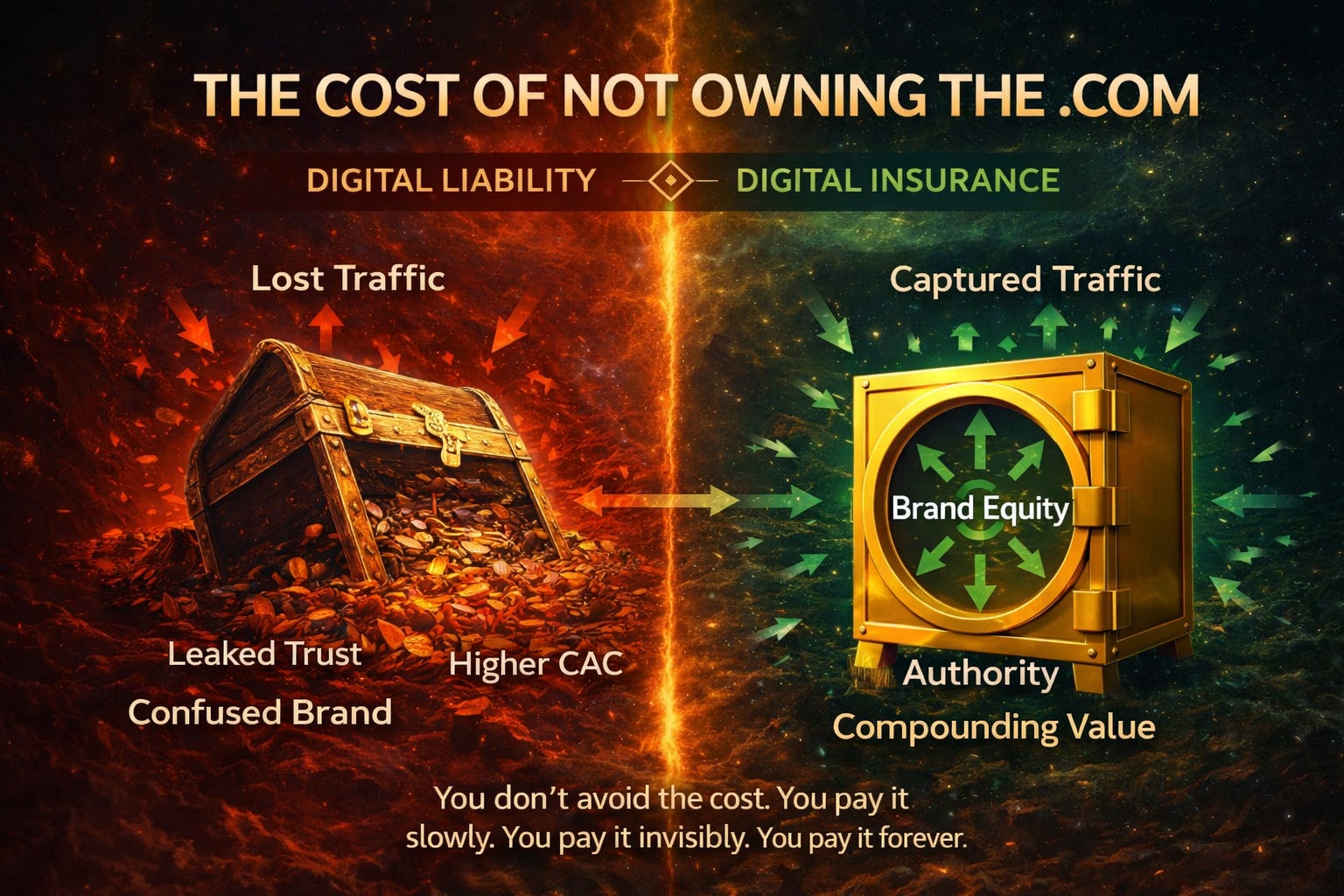
The Invisible Tax of Not Owning the .COM
Let’s say you’re running a $1 million company on a non-.com domain.
You invest in:
Advertising
PR
SEO
Sales teams
Partnerships
Every dollar you spend is teaching the market one thing:
“This name matters.”
But you don’t own the exact-match .com.
Someone else does.
That means every impression, every referral, every brand mention is quietly reinforcing someone else’s asset.
You’re not avoiding the cost.
You’re underwriting it.
Scale Doesn’t Fix This. It Exposes It.
At $10 million, you’re no longer just selling.
You’re training:
Customers
Journalists
Investors
Search engines
to associate success with a name you don’t control.
At $100 million, the drag becomes measurable:
Higher acquisition costs
Lost type-in traffic
Brand confusion
Trust leakage
Every campaign leaks a little value.
Every year.
Forever.
At $1 billion, it’s no longer a debate.
It’s malpractice.
You’ve built a global brand while sending free authority, recall, and trust to someone sitting quietly on the .com you should have owned from day one.
This Is Not About Ego or Status
Owning the .com isn’t about pride.
It’s about percentages.
A few points of friction here.
A few points of confusion there.
Compounded over years, that becomes tens or hundreds of millions in lost value.
The most dangerous costs in business are the ones you don’t see line by line on a P&L.
They don’t disappear.
They just show up later.
Bigger.
More expensive.
Harder to fix.
The Owner of the .COM Doesn’t Need to Do Anything
Here’s the part most people miss.
The .com owner:
Doesn’t advertise
Doesn’t hire
Doesn’t take risk
Doesn’t build
They simply own the leverage.
You create the demand.
They capture the upside.
That’s asymmetric economics — and it always favors the owner of the scarce asset.
“But Companies Succeed Without the .COM”
Of course they do.
People also succeed with bad tax strategies, inefficient supply chains, and bloated payrolls.
Success doesn’t mean optimization.
It means you succeeded despite the drag — not because it wasn’t there.
If you don’t own the .com, you’re building with friction baked in:
Slower growth
Higher CAC
Brand leakage
Long-term downside risk
That cost compounds whether you acknowledge it or not.
You Don’t Avoid the Cost. You Choose How You Pay It.
You don’t save money by skipping the .com.
You pay it anyway:
Slowly
Invisibly
Forever
And if you’re still arguing this point, you’re not being strategic.
You’re being cheap.
And cheap is the most expensive mistake in business.
It always has been.
It always will be.
No offense intended.
Just the math.
Conclusion:
The Meter Is Always Running
This isn’t about opinions, anecdotes, or edge cases.
It’s about ownership and arithmetic.
If you don’t own the .com, you are building value on land you don’t control. Every dollar you spend, every customer you educate, every headline you earn quietly strengthens an asset owned by someone else.
You don’t escape the cost by not buying the .com.
You just change how it shows up.
It shows up as higher acquisition costs.
It shows up as confusion.
It shows up as slower compounding over time.
Those costs don’t disappear because they’re invisible. They accumulate while the owner of the .com captures leverage without lifting a finger.
You can absolutely build without the .com. People do it every day.
But you’ll do it with drag built in—and drag always gets more expensive as you scale.
The math is simple:
You either pay once to own the asset,
or you pay forever to promote it for someone else.
There is no third option.
Just the math.