


Most people believe the world’s largest asset class is stocks.
Others say gold.
Some argue oil.
A growing crowd screams Bitcoin.
They’re all wrong.
Real estate is the largest asset class on Earth.
Bigger than equities. Bigger than commodities. Bigger than crypto.
And yet, almost no one has connected the most important modern truth:
Domain names are digital real estate.
And the .com is the land under the building.
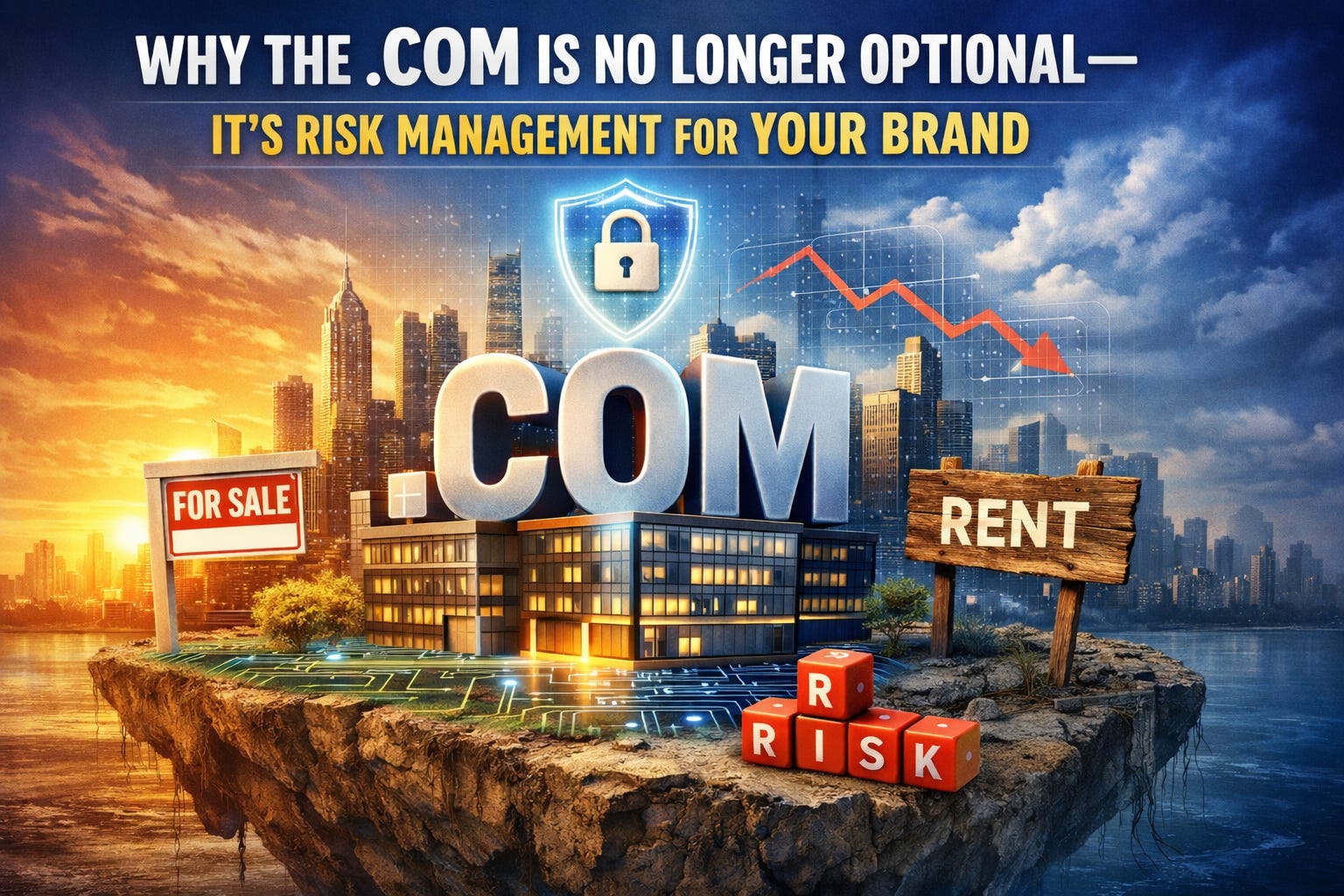
The Internet Has Land. You’re Either Owning It—or Renting It
In the physical world, no serious company would build its headquarters on land it doesn’t own—especially if a competitor could buy the plot next door and redirect customers.
But online?
Companies do this every single day.
They build brands.
They spend millions on marketing.
They pour years into trust and reputation.
All while not owning the .com.
That’s not innovation.
That’s exposure.
When you don’t own the .com version of your brand, you’re operating on leased land in the most competitive environment in human history—the global internet.
The .COM Is Not a URL
It’s Digital Insurance
Owning the .com isn’t about vanity.
It’s not about being “old school.”
It’s not even about SEO anymore.
It’s about insurance.
Digital insurance against risks most companies don’t even see—until it’s too late.
Insurance against lost traffic
Customers will type the .com by instinct. Always have. Always will.
If you don’t own it, someone else captures your demand.
Insurance against brand confusion
Emails go missing. Links get mistyped. Trust gets diluted.
Every confusion costs you credibility.
Insurance against higher marketing costs
You pay more forever to educate users, fix mistakes, and redirect attention—because you chose not to secure the obvious asset.
Insurance against competitors and scammers
If you don’t control your name, someone else will—whether it’s a competitor, a squatter, or a bad actor running ads on your brand.
Insurance against erosion you’ll never see on a balance sheet
The most dangerous losses don’t show up in reports.
They show up in missed opportunities, lower conversion rates, and silent leaks in your funnel.
Every Serious Business Insures Its Biggest Assets
Factories are insured.
Inventory is insured.
Employees are insured.
Data is insured.
But somehow, the brand—the thing everything depends on—is left exposed.
That’s not strategy.
That’s a blind spot.
Your brand is an asset.
Your domain is the title deed.
Not Owning the .COM Is Self-Insurance—and It’s the Worst Kind
If you don’t own the .com, you’re self-insuring a risk you:
• Don’t fully understand
• Can’t properly quantify
• Can’t control once it escalates
And once it bites you, the price is no longer negotiable.
Domains don’t get cheaper after success.
They get exponentially more expensive.
Ask any company that had to buy its .com after becoming successful.
Digital Real Estate Follows the Same Rules as Physical Real Estate
✔ Scarcity
✔ Location matters
✔ First movers win
✔ Prime assets are never replaced
There is only one exact-match .com for any brand.
Once it’s owned, it’s owned.
No amount of AI, apps, social media, or marketing hacks will change that.
The Smartest Companies Don’t Ask “Do We Need the .COM?”
They ask:
“Can we afford not to own it?”
Because in the digital economy, the land matters more than the building.
And the most valuable land online still ends in .com.
Final Thought
You wouldn’t build your future on rented land without a contract.
You wouldn’t ignore insurance on your most valuable asset.
So why do it with your brand?
Own the land. Secure the .com. Eliminate the risk before it eliminates you.