


Many founders assume premium domains are only for Fortune 500 companies or venture-backed startups.
Others overpay because they rush into negotiations without understanding how the premium domain market works.
The reality is somewhere in between.
Premium domains range from a few hundred dollars to millions, and with the right approach, many businesses can acquire exceptional names without stretching their budget.
Here’s how to make a smart purchase.
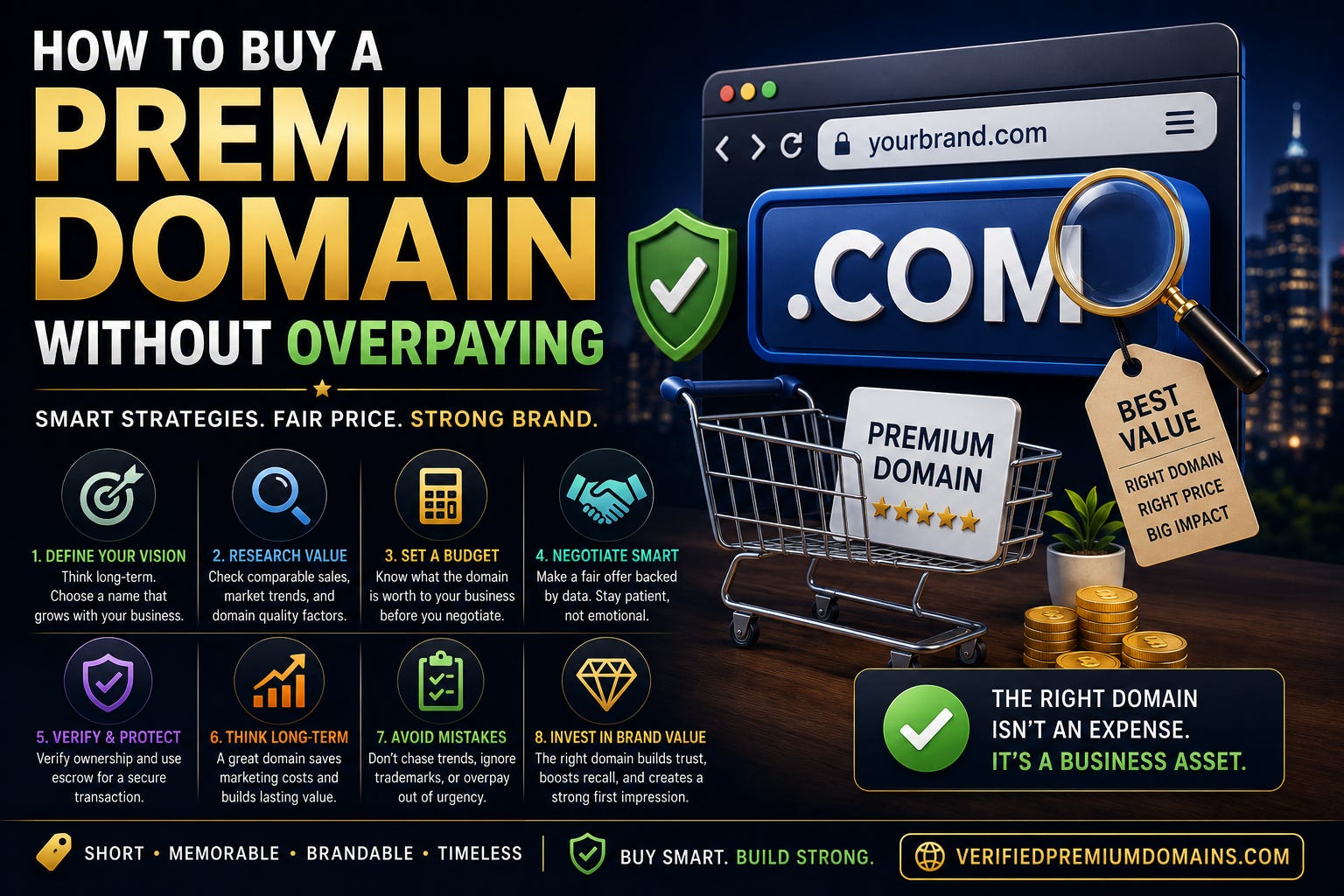
Start With Your Long-Term Vision
Before searching for domains, answer one question:
Where do you want your business to be in five years?
Many founders buy a domain that fits today’s product instead of tomorrow’s company.
Imagine launching:
AIInvoiceGenerator.com
Two years later, you expand into payroll, accounting, and finance software.
Now your brand no longer reflects your business.
A premium domain should support your future—not just your MVP.
Know What Actually Makes a Domain Valuable
Not every expensive domain is worth its asking price.
Premium domains usually have qualities such as:
Short length
Easy spelling
Easy pronunciation
Strong brandability
Broad commercial appeal
Matching .com extension
Timeless relevance
Price alone doesn’t define quality.
Evaluate the domain based on its branding potential.
Set a Realistic Budget
Many buyers make one of two mistakes:
They expect a world-class domain for a standard registration fee.
They assume every premium domain costs six figures.
Neither is true.
Premium domains exist across a wide range of prices.
Decide what the domain is worth to your business before entering negotiations.
Think of it as a long-term brand investment rather than a short-term expense.
Research Comparable Sales
Before making an offer, study similar domain sales.
Look at factors like:
Length
Keywords
Industry
Extension
Brandability
Comparable sales provide useful context and help you understand whether an asking price is reasonable.
No two domains are identical, but market history can guide your expectations.
Don’t Negotiate With Emotion
Founders often become emotionally attached to a single name.
That weakens their negotiating position.
Instead:
Stay patient.
Ask questions.
Understand the seller’s expectations.
Focus on business value, not excitement.
Good negotiations are based on preparation—not urgency.
Avoid Buying Based Only on SEO Keywords
Years ago, exact-match keyword domains played a much larger role in search rankings.
Today, search engines prioritize content quality, relevance, and user experience.
A memorable brand often creates more long-term value than a domain filled with keywords.
Compare:
Atlas.com
with
BestProjectManagementSoftwareOnline.com
One builds a brand.
The other describes a product.
Brands generally have greater long-term flexibility.
Consider the Cost of Waiting
Many founders postpone buying the right domain because they hope the price will decrease.
Sometimes it does.
Sometimes another buyer acquires it.
Or your own business grows, making the domain even more important—and more expensive to negotiate.
Waiting has a cost too.
Factor that into your decision.
Verify Ownership
Before sending payment, confirm that the seller actually controls the domain.
Ask for proof of ownership if you’re dealing directly with an individual.
Using reputable escrow services or trusted marketplaces adds another layer of security and helps protect both buyer and seller during the transaction.
Think Beyond the Purchase Price
The acquisition cost is only one part of the equation.
Ask yourself:
Will this domain reduce future marketing costs?
Will customers remember it more easily?
Will it strengthen trust?
Will it reduce confusion?
Could it eliminate the need for a future rebrand?
Sometimes paying more today saves significantly more over the next decade.
Don’t Assume the Asking Price Is Final
Many premium domains have room for negotiation.
That doesn’t mean every seller will lower the price.
But respectful, informed discussions often lead to agreements that benefit both sides.
If you make an offer, support it with logic rather than emotion.
Work With Professionals When Needed
If you’re negotiating for a high-value domain or an important brand asset, experienced brokers can help by:
Contacting owners
Managing negotiations
Preserving buyer anonymity
Coordinating escrow
Reducing transaction risk
For many businesses, professional guidance can be well worth the cost.
Watch Out for These Common Mistakes
Avoid these pitfalls:
Buying the first available name without research.
Choosing a domain because it’s cheap rather than memorable.
Ignoring trademark considerations.
Forgetting to budget for branding and marketing.
Assuming all premium domains are overpriced.
Letting urgency drive negotiations.
Smart buyers think strategically, not impulsively.
Questions to Ask Before You Buy
Before purchasing any premium domain, ask yourself:
Does this name still make sense if my company grows?
Is it easy to pronounce and spell?
Will customers remember it?
Does it inspire confidence?
Is it aligned with my brand?
Would I still be happy owning this domain five years from now?
If the answer is yes, you’re evaluating the purchase from a long-term perspective.
Premium Domains Are Business Assets
Unlike advertising campaigns, software subscriptions, or office rent, a premium domain is a digital asset.
It becomes part of:
Your website
Your email addresses
Your marketing
Your investor presentations
Your reputation
Your brand equity
The right domain supports every stage of your company’s growth.
Final Thoughts
Buying a premium domain isn’t about finding the lowest possible price.
It’s about finding the best possible value.
The strongest purchases happen when founders understand their long-term goals, research the market, negotiate thoughtfully, and invest in a name that can grow with the business.
A premium domain shouldn’t feel expensive.
It should feel like a foundation you’ll still be glad you built years from now.