


Premium domain names are valuable digital assets.
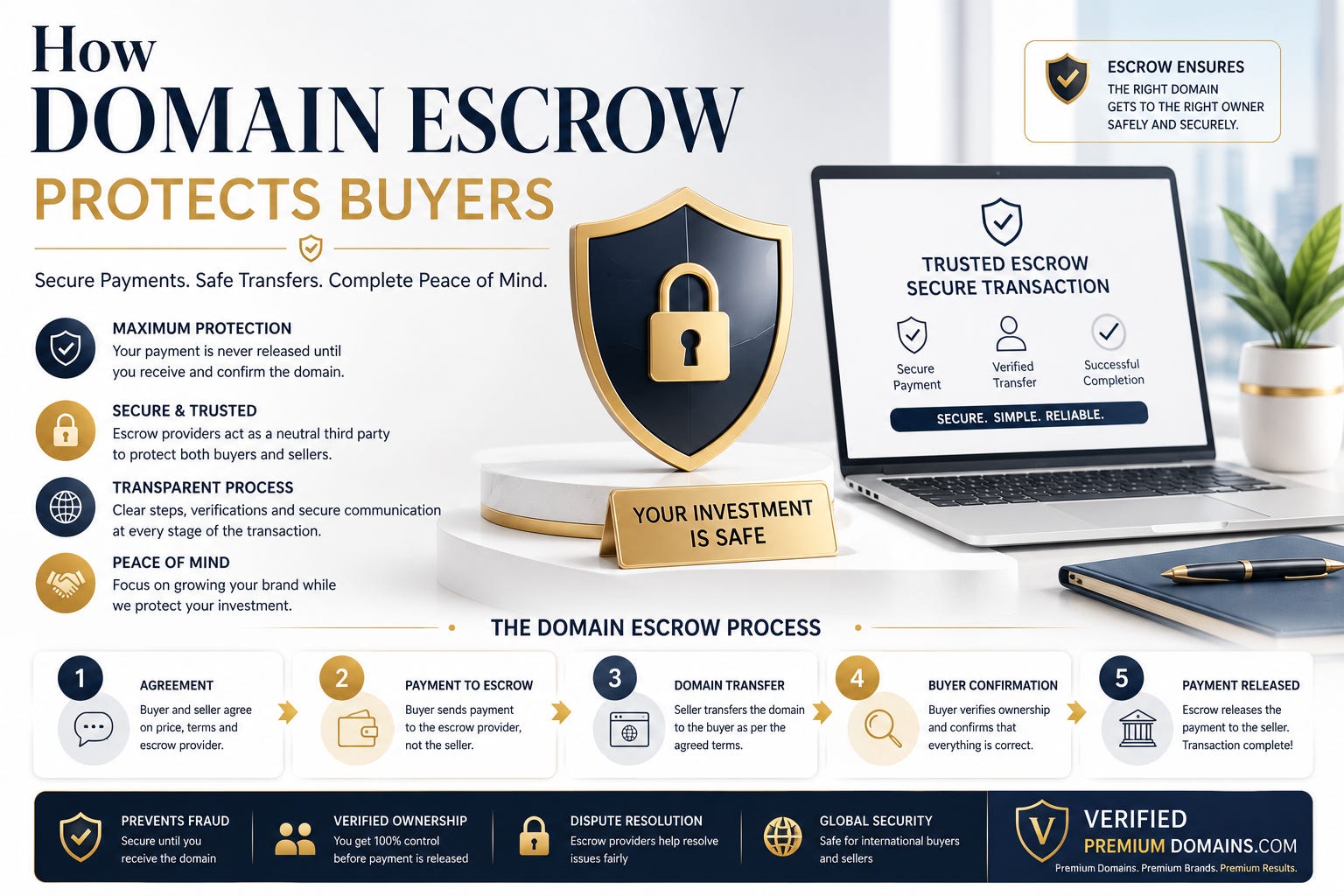
Unlike ordinary online purchases, a domain transaction usually involves:
A unique asset
Two parties who may have never met
A significant amount of money
A transfer that cannot easily be reversed
Without safeguards, either side could be exposed to unnecessary risk.
Domain escrow solves this problem by acting as a trusted neutral third party.
What Is Domain Escrow?
Domain escrow is a secure transaction process where an independent escrow service temporarily holds the buyer’s payment until the domain has been successfully transferred.
Instead of sending money directly to the seller, both parties follow a structured process that protects everyone involved.
Think of escrow as a trusted referee.
The buyer knows the money won’t be released until they receive the domain.
The seller knows the buyer has already secured the funds before transferring ownership.
Why Buyers Should Never Skip Escrow
Imagine sending $25,000 directly to someone for a premium domain.
What happens if:
The seller disappears?
The domain is never transferred?
The seller doesn’t actually own it?
The transfer fails?
Recovering funds can become extremely difficult.
Escrow dramatically reduces these risks.
How a Domain Escrow Transaction Works
Most domain escrow transactions follow a simple sequence.
Step 1: Buyer and Seller Agree
Both parties agree on:
Purchase price
Payment terms
Transfer timeline
Escrow provider
Nothing is transferred yet.
Step 2: Buyer Sends Payment
The buyer sends funds to the escrow company—not directly to the seller.
The escrow provider verifies the payment has been received.
At this point:
✅ Seller knows the buyer has the funds.
Buyer still controls the transaction because escrow hasn’t released payment.
Step 3: Seller Transfers the Domain
Once payment is verified, the seller transfers the domain to the buyer.
Depending on the registrar, this may involve:
Account push
Authorization code
Registrar transfer
Ownership verification
Step 4: Buyer Confirms Receipt
The buyer verifies:
They control the domain.
Ownership has transferred correctly.
Everything matches the agreement.
Only after confirmation does the process continue.
Step 5: Escrow Releases Payment
Once the buyer confirms successful transfer, escrow releases the funds to the seller.
The transaction is complete.
Both parties receive what they agreed to.
Why Escrow Protects Buyers
Escrow eliminates one of the biggest fears in premium domain purchases:
Paying before receiving ownership.
Instead of trusting a stranger, buyers trust an independent transaction process.
Escrow protects buyers by ensuring:
Payment isn’t released prematurely.
Ownership is verified.
Funds remain secure during the transfer.
Both parties follow the agreed process.
Escrow Also Protects Sellers
Escrow isn’t just for buyers.
It also benefits sellers.
Without escrow, a seller risks transferring a valuable domain before knowing whether payment is genuine.
Escrow confirms that:
Funds have been received.
Payment has cleared.
The buyer is financially committed.
Only then does the seller proceed with the transfer.
What Escrow Doesn’t Do
Escrow secures the transaction.
It does not determine whether a domain is a good investment.
Buyers should still research:
Brand quality
Comparable sales
Trademark risks
Commercial potential
Market demand
Escrow protects the transaction—not the buying decision.
Common Buyer Concerns
“What if the seller disappears?”
The seller doesn’t receive payment until the transfer process is completed.
“What if the domain isn’t transferred?”
Escrow holds the funds.
If the agreed conditions aren’t met, the transaction can be cancelled according to the escrow provider’s procedures.
“What if ownership information is incorrect?”
Ownership should be verified before funds are released.
Professional escrow processes are designed to reduce this risk.
Transactions Without Escrow Are Riskier
Direct payments may seem faster.
They also remove an important layer of protection.
Without escrow:
Money may be difficult to recover.
Disputes become harder to resolve.
Fraud risk increases.
Trust depends entirely on the other party.
For valuable domains, the potential downside usually outweighs the small amount of time or cost saved.
When Should You Use Escrow?
Escrow is recommended for almost every premium domain purchase, especially when:
Buying directly from an individual.
Purchasing from an investor.
Acquiring a high-value brand.
Working with an unfamiliar seller.
Completing an international transaction.
Many professional marketplaces and brokers also use escrow as part of their standard process.
Additional Benefits
Professional escrow services often provide:
Secure payment handling
Identity verification
Transaction records
Dispute procedures
Transparent communication
Confidence for both parties
These features help make premium domain acquisitions smoother and more secure.
Questions Every Buyer Should Ask
Before completing a domain purchase, ask:
Will escrow be used?
Who is providing the escrow service?
When will payment be released?
How will ownership be verified?
What happens if the transfer fails?
Clear answers reduce uncertainty and help avoid misunderstandings.
Peace of Mind Has Value
Buying a premium domain is often one of the most important branding investments a company will make.
Using escrow allows buyers to focus on building their business rather than worrying about transaction risk.
The small cost of escrow is often insignificant compared to the value of the asset being protected.
Final Thoughts
Trust is important.
Verification is better.
Domain escrow gives buyers confidence that their money is protected until ownership is successfully transferred, while giving sellers confidence that payment is secure before releasing the domain.
It’s one of the simplest—and smartest—ways to reduce risk in premium domain transactions.
When you’re investing in a valuable digital asset, security shouldn’t be optional.
It should be part of the process.