


Many people proudly say they “own a business.”
But a harder question is rarely asked:
What happens when you stop showing up?
If growth stalls, revenue drops, or everything pauses the moment you step away, then ownership may be an illusion. What you really have is a job—often a demanding one with longer hours and higher stress than employment.
The real distinction isn’t between working hard and working less.
It’s between effort-based income and asset-based growth.
Effort vs. Leverage: The Critical Difference
Most people confuse activity with progress.
They:
Stay busy
Put in long hours
Respond to messages constantly
Handle everything personally
This creates motion, not leverage.
Leverage exists when:
Work done once produces value repeatedly
Systems replace constant decisions
Growth continues without daily intervention
True ownership begins when results are no longer tied directly to your presence.
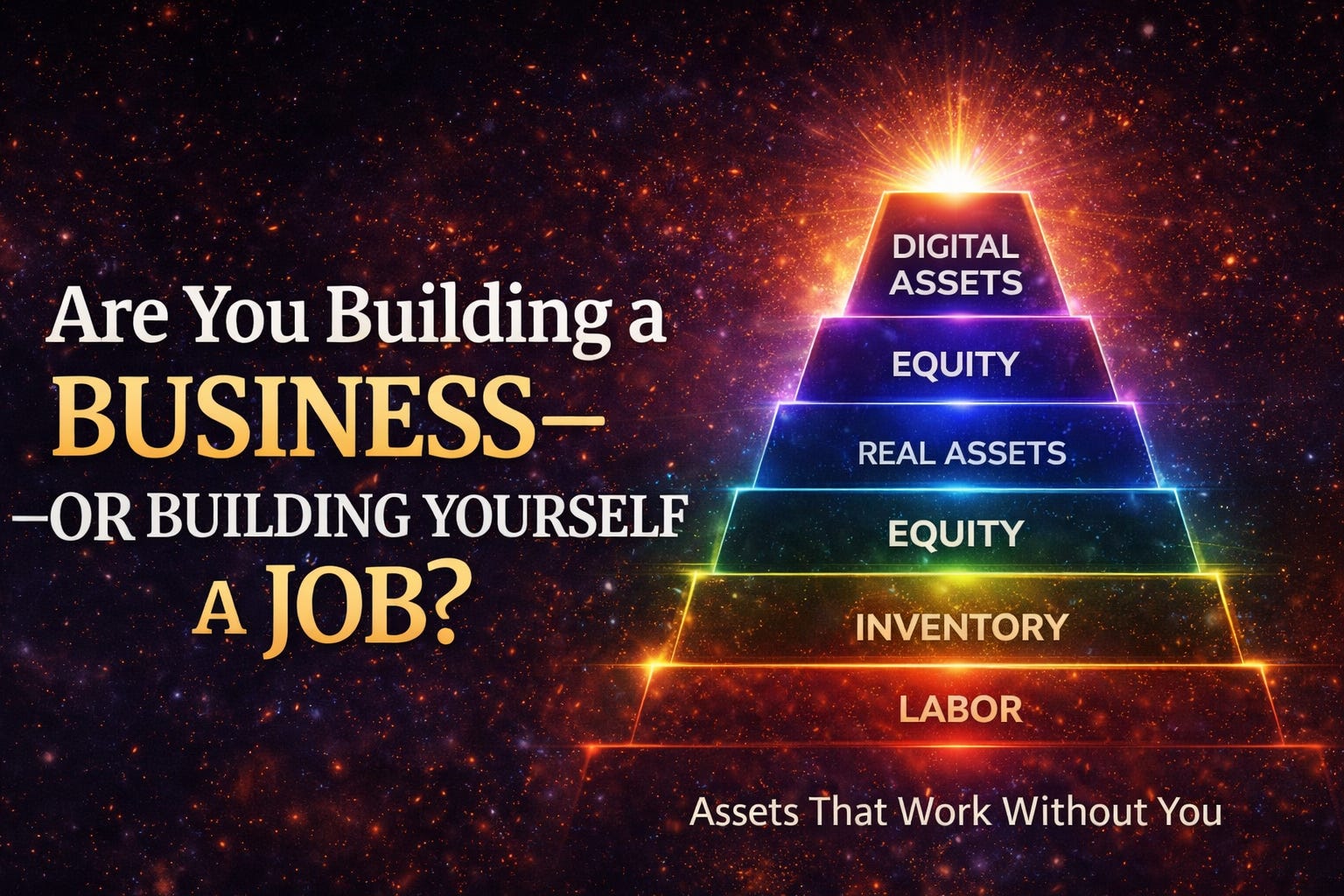
The Asset Ladder: From Time to Independence
Not all income sources are equal. Some scale with your time. Others scale without you.
Here’s how value typically stacks:
1. Labor
You trade hours for money.
When you stop working, income stops.
2. Business (Owner-Dependent)
You manage people, clients, operations.
Income exists—but only if you stay involved.
3. Inventory
Products can be sold repeatedly, but still require management, logistics, and attention.
4. Real Assets
Systems or properties that generate value with minimal daily input.
5. Equity
Ownership in scalable ventures where value compounds over time.
6. Digital Assets
Assets that can be created once and distributed infinitely at near-zero marginal cost.
The higher you move, the less your time is the bottleneck.
The Wake-Up Test
A simple rule exposes the truth:
If it needs you awake to grow, it isn’t an asset. It’s a job.
This doesn’t mean you don’t work.
It means your work is focused on building systems, not babysitting outcomes.
What Real Ownership Looks Like
True ownership has a few clear signals:
Decisions are documented, not constantly repeated
Processes run without daily supervision
Revenue isn’t fragile
Growth is intentional, not accidental
Time off doesn’t create anxiety
You become a builder of engines, not the fuel that keeps them running.
Building Assets Without Quitting Everything
This isn’t about abandoning your current work overnight.
It’s about shifting your mindset:
Build once, sell many times
Replace manual actions with systems
Create things that compound
Optimize for scalability, not busyness
Every decision should answer one question:
Does this reduce my future dependence on my time?
The Long Game
Short-term effort pays bills.
Long-term assets build freedom.
Most people spend years climbing faster—
only to realize they were on the wrong ladder.
The goal isn’t to work less today.
The goal is to own more tomorrow.
Because the ultimate measure of success isn’t how hard you work—
It’s whether what you’ve built can work without you.
Conclusion: Build What Outlives Your Effort
At some point, everyone must face the same question:
Am I building momentum—or am I just staying busy?
Jobs reward presence.
Assets reward foresight.
The shift from effort-driven work to asset-driven ownership doesn’t happen by accident. It happens when you intentionally design your work to compound, when you prioritize systems over hustle, and when you measure success not by hours spent, but by independence gained.
This isn’t about escaping work.
It’s about earning the right to choose how and when you work.
Build things that grow when you rest.
Build things that don’t collapse in your absence.
Build things that create leverage instead of dependency.
Because in the end, the most valuable asset you can own
is control over your time.