


Most founders default to one path: raise venture capital. It’s the most visible, the most talked about, and often the most misunderstood. But the reality is far more nuanced. There are multiple funding routes—each with its own trade-offs, timelines, and strategic implications.
If you’re building something meaningful, choosing how you fund it is just as important as what you build.
Here’s a grounded look at eight funding paths founders often overlook—and when they actually make sense.
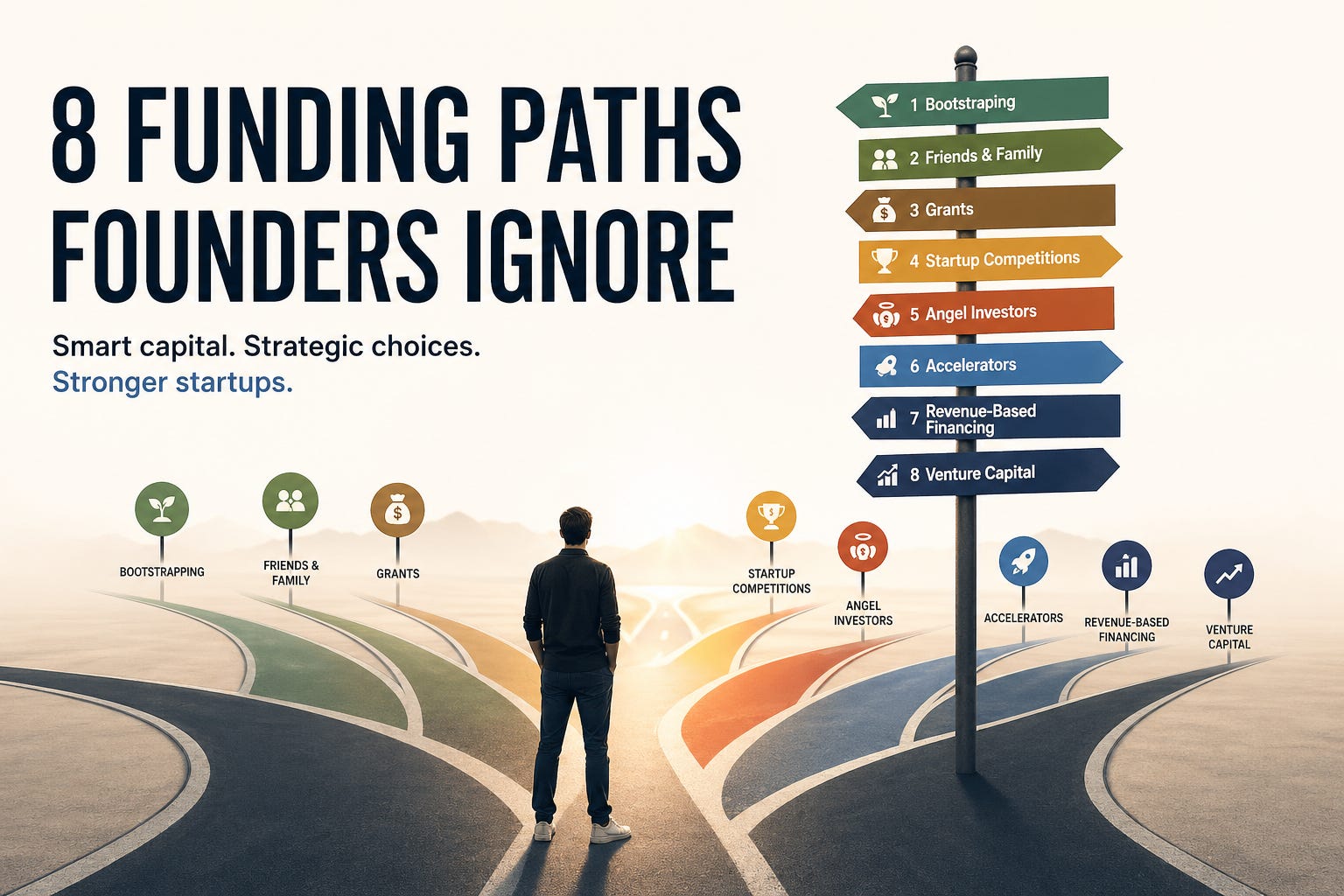
1. Bootstrapping: Maximum Control, Slower Speed
Bootstrapping means building with your own resources—no external capital, no dilution.
It’s the cleanest path in terms of ownership. You make the decisions. You keep the upside.
But there’s a cost: speed.
Without external capital, growth tends to be slower, and the financial pressure sits entirely on you. That said, many of the most durable businesses started this way because it forces discipline—real revenue, real customers, real efficiency.
Best for: Founders who value control and can generate early cash flow.
2. Friends & Family: Fast Capital, Hidden Complexity
This is often the first external money founders raise. It’s accessible, flexible, and typically comes with fewer formalities.
But the real risk isn’t financial—it’s relational.
Mixing money with personal relationships can create long-term tension if expectations aren’t aligned. Many founders underestimate this.
Best for: Early-stage founders who need a small initial push—but only with clear, written terms.
3. Grants: Non-Dilutive, But Slow
Grants are one of the most underused funding sources. They provide capital without taking equity.
The catch? Time and eligibility.
They often come with long application cycles (3–12 months) and are usually tied to specific sectors like deep tech, climate, biotech, or social impact.
Most founders miss them simply because they apply too late—or not at all.
Best for: Startups in research-heavy or impact-driven sectors with patience for longer timelines.
4. Startup Competitions: Visibility Over Cash
Competitions offer modest funding, but the real value isn’t the check—it’s exposure.
Winning or even participating can open doors to investors, partners, and media attention. The introductions often outweigh the prize money.
But don’t rely on them as a primary funding strategy.
Best for: Early-stage startups looking to build credibility and network.
5. Angel Investors: Smart Money, Expensive Equity
Angel investors bring more than capital—they bring experience, networks, and strategic guidance.
But that comes at a price. The equity you give up at this stage is often the most expensive you’ll ever sell.
Still, the right angel can accelerate your trajectory significantly.
Best for: Pre-seed or seed startups that need both capital and mentorship.
6. Accelerators: Network and Validation
Accelerators offer structured programs, small capital injections, and access to a strong network.
They can fast-track your learning curve and improve your chances of raising future rounds.
However, they’re only truly valuable if they lead to follow-on funding or meaningful connections. Otherwise, the equity cost may not justify the outcome.
Best for: Founders who need guidance, credibility, and investor access early on.
7. Revenue-Based Financing: Growth Without Dilution
This model is gaining traction, especially among SaaS businesses.
You receive capital upfront and repay it as a percentage of your revenue—no equity involved.
It’s predictable and non-dilutive, but comes with consistent repayment obligations regardless of growth fluctuations.
Best for: Companies with stable, recurring revenue streams.
8. Venture Capital: Scale at a Cost
Venture capital is built for speed and scale. Large checks, aggressive growth expectations, and long-term exit pressure.
It works best in markets with massive upside potential—where becoming a billion-dollar company is realistic.
But it fundamentally changes your company. You’re no longer just building a business—you’re building toward a liquidity event.
Best for: High-growth startups targeting large markets and willing to trade control for scale.
The Real Insight: There’s No “Best” Path
Most founders make one critical mistake—they treat funding as a goal.
It’s not.
Funding is a tool. The right choice depends on your business model, market size, risk tolerance, and personal priorities.
Some of the strongest companies combine multiple paths:
Bootstrapping early, then raising angels
Using grants before venture capital
Leveraging revenue-based financing to delay dilution
The smartest founders don’t follow trends—they design their funding strategy intentionally.
Final Thought
The question isn’t “How do I raise money?”
It’s: “What kind of company am I trying to build—and what funding path aligns with that?”
Answer that honestly, and the right path becomes much clearer.