


The biggest companies in the world didn’t become valuable because of their names—but they chose names that were built to scale with their ambitions.
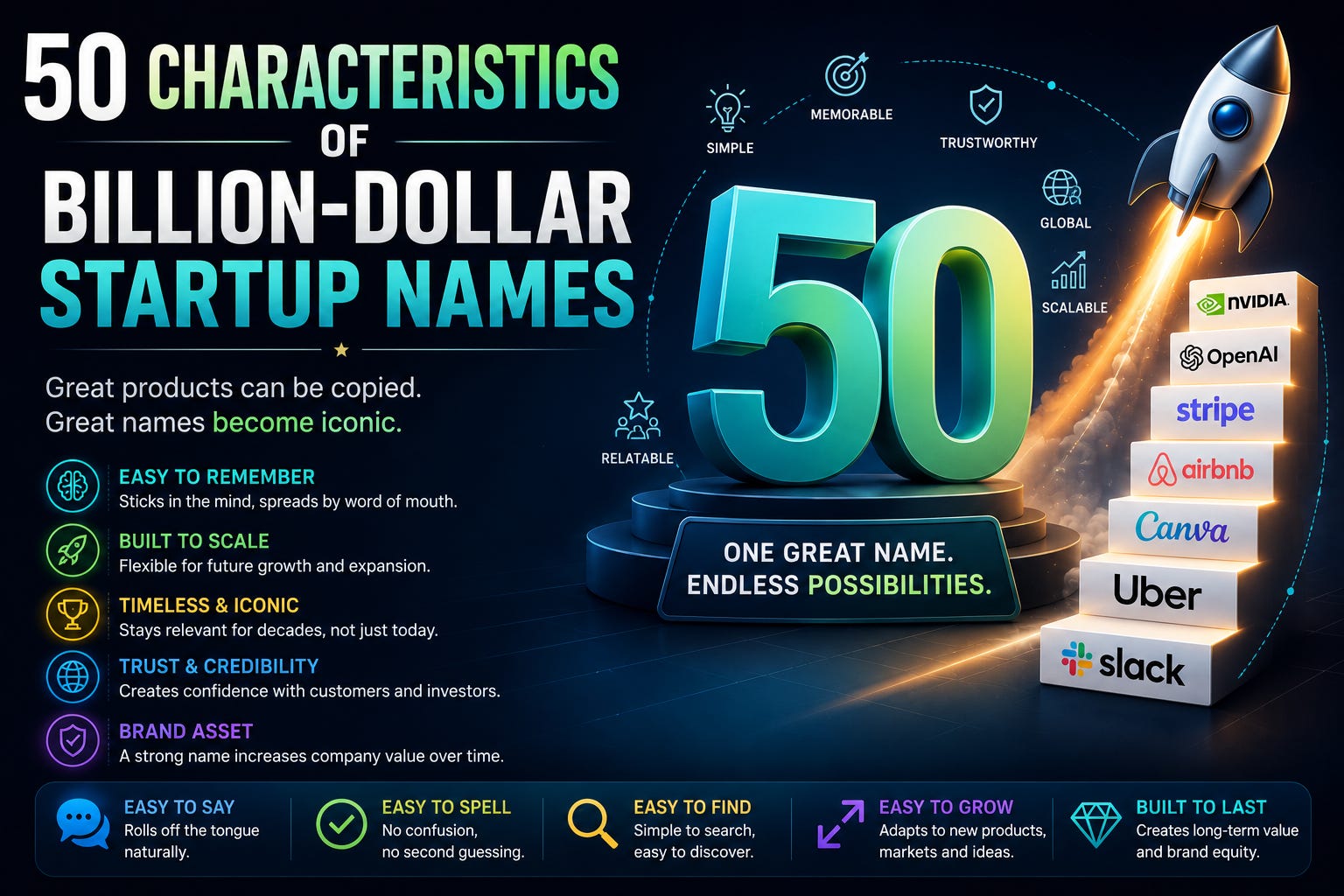
Some of the world’s most recognizable companies have names that are surprisingly simple.
Stripe.
Uber.
Apple.
Nvidia.
Canva.
Zoom.
OpenAI.
Slack.
None of these names explain exactly what the company does.
Instead, they do something far more important—they’re memorable.
If you’re naming a startup today, don’t ask, “What sounds clever?”
Ask, “What can become a billion-dollar brand?”
Here are 50 characteristics that many of today’s most successful startup names share.
Simplicity
1. Short
Fewer letters are easier to remember.
2. Easy to pronounce
If people hesitate when saying it, they’ll hesitate recommending it.
3. Easy to spell
Customers shouldn’t need to ask, “How do you spell that?”
4. Easy to type
Less typing means less friction.
5. Easy to remember
A name heard once should be remembered later.
Brandability
6. Distinctive
Avoid names that sound like dozens of competitors.
7. Original
Create a unique identity instead of copying trends.
8. Ownable
The name should feel like it belongs exclusively to your company.
9. Flexible
Leave room to expand into new products and markets.
10. Timeless
Choose a name that still feels relevant ten years from now.
Clarity
11. Doesn’t confuse customers
People should instantly recognize it as a brand.
12. Avoids unnecessary complexity
Simple names spread faster.
13. Doesn’t require explanation
If you must explain your name, it’s probably too complicated.
14. Sounds natural in conversation
Great brands fit effortlessly into everyday language.
15. Passes the radio test
Someone hearing it once should know how to search for it.
Emotional Impact
16. Inspires curiosity
The best names invite people to learn more.
17. Creates confidence
Strong names often feel established before the company becomes established.
18. Sounds premium
Perception influences trust.
19. Feels professional
Avoid gimmicky spelling.
20. Builds credibility
People often judge quality before trying the product.
Growth Potential
21. Not tied to one feature
Products evolve.
Brands endure.
22. Not tied to one technology
Today’s technology may change tomorrow.
23. Works internationally
Consider pronunciation across different languages.
24. Doesn’t limit expansion
Think beyond your first product.
25. Can support multiple product lines
Strong brands grow without changing names.
Marketing
26. Memorable in advertising
The easier it is to remember, the harder your marketing works.
27. Looks good in a logo
Visual simplicity matters.
28. Fits on mobile screens
Most people discover brands on phones.
29. Works in social media
Shorter names are easier to mention and tag.
30. Easy to share verbally
Word-of-mouth remains one of the strongest marketing channels.
Digital Presence
31. Has an obtainable domain
A memorable name deserves a memorable domain.
32. Preferably owns the .com
Many users still expect companies to use .com.
33. Consistent across platforms
Matching usernames improve brand consistency.
34. Easy to search
Avoid names that compete with common dictionary words unless your brand is strong enough to own them.
35. Easy to recognize in search results
Clarity improves click-through rates.
Competitive Advantage
36. Doesn’t imitate competitors
Following naming trends makes your company easier to forget.
37. Stands apart in your industry
Differentiation begins with the name.
38. Doesn’t rely on buzzwords
Words like “AI,” “Tech,” or “Solutions” may become outdated or overused.
39. Sounds like a company, not just a product
Think bigger than your MVP.
40. Ages well
Avoid names that feel trendy today but dated tomorrow.
Investor Perspective
41. Feels scalable
Investors back companies designed for growth.
42. Signals ambition
Great names often suggest long-term vision.
43. Supports premium positioning
Brand perception affects customer expectations.
44. Creates trust quickly
First impressions matter.
45. Fits enterprise customers
Large organizations often prefer clear, professional brands.
Long-Term Value
46. Protects brand equity
Changing your name later is expensive.
47. Becomes more valuable over time
As your reputation grows, so does the value associated with your name.
48. Represents your vision
Your name should support where you’re going, not just where you’re starting.
49. Makes people remember you
Memorability compounds with every interaction.
50. Feels like it could become iconic
The ultimate test:
Can you imagine this name on the Nasdaq, at a global conference, or on the side of a skyscraper?
If the answer is yes, you’re probably thinking like a long-term founder.
A Quick Reality Check
Before committing to a startup name, ask yourself:
Can someone pronounce it after seeing it once?
Can they spell it correctly?
Will they remember it tomorrow?
Does it leave room for future growth?
Is the matching .com available or realistically obtainable?
Would it still make sense if your company expanded globally?
If you answer “no” to several of these questions, it may be worth refining your name before investing heavily in branding and marketing.
Final Thoughts
A billion-dollar company isn’t created by its name alone.
Execution, innovation, timing, and customer value matter far more.
But a strong name removes friction, strengthens branding, and creates an identity that can grow alongside the business.
Choose a name that’s memorable, flexible, and built for the long term—not just one that’s available today.
Because while products evolve, great brands endure.